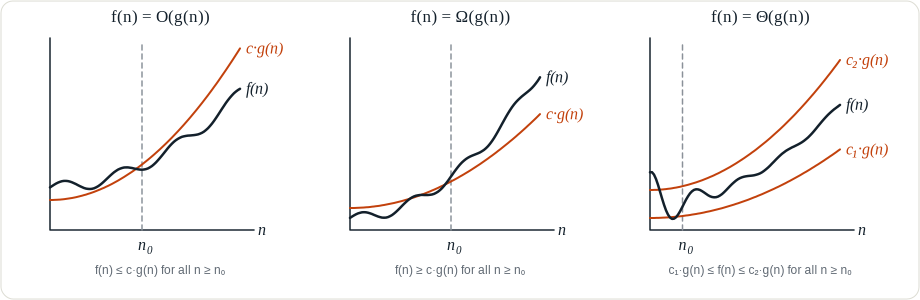
To compare growth rates we need a precise language. Big-O, Omega (Ω) and Theta (Θ) let us say “this function grows no faster than”, “no slower than” or “at the same rate as” another function, while ignoring constant factors and small inputs.
Intuition
Compare a cycle and a car on a trip. For a 100-metre trip, the cycle may even win (no parking, no traffic lights). For a 500-km trip the car always wins. Asymptotic notation only cares about the long trip: what happens when n n n c c c n 0 n_0 n 0 n 0 n_0 n 0 c c c
Big-O: an upper bound
Definition 1.5 · Big-O notation
For functions f ( n ) f(n) f ( n ) g ( n ) g(n) g ( n ) f ( n ) = O ( g ( n ) ) f(n) = O(g(n)) f ( n ) = O ( g ( n )) c c c n 0 n_0 n 0 0 ≤ f ( n ) ≤ c ⋅ g ( n ) for all n ≥ n 0 . 0 \le f(n) \le c \cdot g(n) \quad \text{for all } n \ge n_0. 0 ≤ f ( n ) ≤ c ⋅ g ( n ) for all n ≥ n 0 .
In words: from n 0 n_0 n 0 f f f c c c g g g upper bound g g g 3 n + 4 3n + 4 3 n + 4 O ( n ) O(n) O ( n ) O ( n 2 ) O(n^2) O ( n 2 ) O ( n 3 ) O(n^3) O ( n 3 )
Example 1.6 Prove 3n + 4 = O(n)
Goal. Find positive constants c c c n 0 n_0 n 0 3 n + 4 ≤ c ⋅ n 3n + 4 \le c \cdot n 3 n + 4 ≤ c ⋅ n n ≥ n 0 n \ge n_0 n ≥ n 0 Pick c. Try c = 4 c = 4 c = 4 3 n + 4 ≤ 4 n 3n + 4 \le 4n 3 n + 4 ≤ 4 n Solve for n. Subtract 3 n 3n 3 n 4 ≤ n 4 \le n 4 ≤ n n ≥ 4 n \ge 4 n ≥ 4 Check one value. At n = 4 n = 4 n = 4 3 ( 4 ) + 4 = 16 3(4) + 4 = 16 3 ( 4 ) + 4 = 16 4 ⋅ 4 = 16 4 \cdot 4 = 16 4 ⋅ 4 = 16 16 ≤ 16 16 \le 16 16 ≤ 16 Result. With c = 4 c = 4 c = 4 n 0 = 4 n_0 = 4 n 0 = 4 3 n + 4 = O ( n ) 3n + 4 = O(n) 3 n + 4 = O ( n )
Omega: a lower bound
Definition 1.7 · Omega notation
We write f ( n ) = Ω ( g ( n ) ) f(n) = \Omega(g(n)) f ( n ) = Ω ( g ( n )) c c c n 0 n_0 n 0 0 ≤ c ⋅ g ( n ) ≤ f ( n ) for all n ≥ n 0 . 0 \le c \cdot g(n) \le f(n) \quad \text{for all } n \ge n_0. 0 ≤ c ⋅ g ( n ) ≤ f ( n ) for all n ≥ n 0 .
In words: from n 0 n_0 n 0 f f f c c c g g g lower bound . For example, 3 n + 4 ≥ 3 n 3n + 4 \ge 3n 3 n + 4 ≥ 3 n n ≥ 1 n \ge 1 n ≥ 1 3 n + 4 = Ω ( n ) 3n + 4 = \Omega(n) 3 n + 4 = Ω ( n ) c = 3 c = 3 c = 3 n 0 = 1 n_0 = 1 n 0 = 1
Correction · Omega needs a positive constant
Study material says: In §1.2, the set definition of Ω(g(n)) says “there exists a constant c and n0 ≥ 0”, without saying that c must be positive.
Correct version: Ω ( g ( n ) ) = { f ( n ) : there exist positive constants c and n 0 such that 0 ≤ c g ( n ) ≤ f ( n ) for all n ≥ n 0 } \Omega(g(n)) = \{ f(n) : \text{there exist positive constants } c \text{ and } n_0 \text{ such that } 0 \le c\,g(n) \le f(n) \text{ for all } n \ge n_0 \} Ω ( g ( n )) = { f ( n ) : there exist positive constants c and n 0 such that 0 ≤ c g ( n ) ≤ f ( n ) for all n ≥ n 0 }
Why: If c = 0 c = 0 c = 0 0 ≤ f ( n ) 0 \le f(n) 0 ≤ f ( n ) Ω \Omega Ω Introduction to Algorithms , §3.1, require c > 0 c > 0 c > 0
Theta: a tight bound
Definition 1.8 · Theta notation
We write f ( n ) = Θ ( g ( n ) ) f(n) = \Theta(g(n)) f ( n ) = Θ ( g ( n )) c 1 c_1 c 1 c 2 c_2 c 2 n 0 n_0 n 0 0 ≤ c 1 ⋅ g ( n ) ≤ f ( n ) ≤ c 2 ⋅ g ( n ) for all n ≥ n 0 . 0 \le c_1 \cdot g(n) \le f(n) \le c_2 \cdot g(n) \quad \text{for all } n \ge n_0. 0 ≤ c 1 ⋅ g ( n ) ≤ f ( n ) ≤ c 2 ⋅ g ( n ) for all n ≥ n 0 .
Θ \Theta Θ f f f g g g g g g asymptotically tight bound for f f f f f f g g g
Theorem 1.9 · Theta is Big-O plus Omega
f ( n ) = Θ ( g ( n ) ) f(n) = \Theta(g(n)) f ( n ) = Θ ( g ( n )) f ( n ) = O ( g ( n ) ) f(n) = O(g(n)) f ( n ) = O ( g ( n )) f ( n ) = Ω ( g ( n ) ) f(n) = \Omega(g(n)) f ( n ) = Ω ( g ( n ))
Big-O Omega (Ω) Theta (Θ) Kind of bound Upper Lower Tight (both) Inequality after n 0 n_0 n 0 f ≤ c g f \le c\,g f ≤ c g f ≥ c g f \ge c\,g f ≥ c g c 1 g ≤ f ≤ c 2 g c_1 g \le f \le c_2 g c 1 g ≤ f ≤ c 2 g Rough analogy f f f g g g f f f g g g f f f g g g 3 n + 4 3n + 4 3 n + 4 O ( n ) O(n) O ( n ) O ( n 2 ) O(n^2) O ( n 2 ) Ω ( n ) \Omega(n) Ω ( n ) Ω ( 1 ) \Omega(1) Ω ( 1 ) only Θ ( n ) \Theta(n) Θ ( n )
Example 1.10 Prove n²/3 − 4n = Θ(n²)
Goal. Find positive c 1 c_1 c 1 c 2 c_2 c 2 n 0 n_0 n 0 c 1 n 2 ≤ 1 3 n 2 − 4 n ≤ c 2 n 2 c_1 n^2 \le \frac{1}{3}n^2 - 4n \le c_2 n^2 c 1 n 2 ≤ 3 1 n 2 − 4 n ≤ c 2 n 2 n ≥ n 0 n \ge n_0 n ≥ n 0
Divide by n². For n > 0 n > 0 n > 0 c 1 ≤ 1 3 − 4 n ≤ c 2 c_1 \le \frac{1}{3} - \frac{4}{n} \le c_2 c 1 ≤ 3 1 − n 4 ≤ c 2
Right-hand side. 1 3 − 4 n \frac{1}{3} - \frac{4}{n} 3 1 − n 4 1 3 \frac{1}{3} 3 1 c 2 = 1 3 c_2 = \frac{1}{3} c 2 = 3 1 n ≥ 1 n \ge 1 n ≥ 1
Left-hand side. 1 3 − 4 n \frac{1}{3} - \frac{4}{n} 3 1 − n 4 n n n n = 13 n = 13 n = 13 13 − 12 39 = 1 39 \frac{13 - 12}{39} = \frac{1}{39} 39 13 − 12 = 39 1 n n n c 1 = 1 39 c_1 = \frac{1}{39} c 1 = 39 1 n ≥ 13 n \ge 13 n ≥ 13
Check with a program. Multiplying every term by 39 keeps whole numbers: we need n 2 ≤ 13 n 2 − 156 n ≤ 13 n 2 n^2 \le 13n^2 - 156n \le 13n^2 n 2 ≤ 13 n 2 − 156 n ≤ 13 n 2
C · theta_check.c Copy #include <stdio.h> /* Check c1*g(n) <= f(n) <= c2*g(n) for f(n) = n*n/3 - 4n, g(n) = n*n, c1 = 1/39 and c2 = 1/3. We multiply every term by 39 so that we can work with whole numbers: n*n <= 13*n*n - 156*n <= 13*n*n */ int main( void ) { printf( " n 39*c1*g(n) 39*f(n) 39*c2*g(n) holds? \n " ); for ( long n = 10 ; n <= 16 ; n ++ ) { long low = n * n; long mid = 13 * n * n - 156 * n; long high = 13 * n * n; printf( "%3ld %12ld %9ld %12ld %s \n " , n, low, mid, high, (low <= mid && mid <= high) ? "yes" : "no" ); } return 0 ; } Output Copy n 39*c1*g(n) 39*f(n) 39*c2*g(n) holds? 10 100 -260 1300 no 11 121 -143 1573 no 12 144 0 1872 no 13 169 169 2197 yes 14 196 364 2548 yes 15 225 585 2925 yes 16 256 832 3328 yes The sandwich fails for n ≤ 12 n \le 12 n ≤ 12 n = 13 n = 13 n = 13
Result. 1 3 n 2 − 4 n = Θ ( n 2 ) \frac{1}{3}n^2 - 4n = \Theta(n^2) 3 1 n 2 − 4 n = Θ ( n 2 ) c 1 = 1 39 c_1 = \frac{1}{39} c 1 = 39 1 c 2 = 1 3 c_2 = \frac{1}{3} c 2 = 3 1 n 0 = 13 n_0 = 13 n 0 = 13
Showing that a bound is false
To show f ( n ) ≠ O ( g ( n ) ) f(n) \ne O(g(n)) f ( n ) = O ( g ( n ))
Example 1.11 Show 6n³ is not Θ(n²)
Goal. Show that no constants make 6 n 3 ≤ c n 2 6n^3 \le c\,n^2 6 n 3 ≤ c n 2 n n n Assume the opposite. Suppose 6 n 3 ≤ c n 2 6n^3 \le c\,n^2 6 n 3 ≤ c n 2 n ≥ n 0 n \ge n_0 n ≥ n 0 Divide by 6 n 2 6n^2 6 n 2 This gives n ≤ c 6 n \le \frac{c}{6} n ≤ 6 c Contradiction. c 6 \frac{c}{6} 6 c n n n n 0 n_0 n 0 c 6 \frac{c}{6} 6 c n = n 0 + c n = n_0 + c n = n 0 + c n ≤ c 6 n \le \frac{c}{6} n ≤ 6 c Result. 6 n 3 ≠ O ( n 2 ) 6n^3 \ne O(n^2) 6 n 3 = O ( n 2 ) 6 n 3 ≠ Θ ( n 2 ) 6n^3 \ne \Theta(n^2) 6 n 3 = Θ ( n 2 )
O, Ω, Θ and the cases of an algorithm
Correction · Big-O is not 'the worst case' and Omega is not 'the best case'
Study material says: §1.2 states that Big-O “is often used to describe the worst case running time” and that Ω “is used to bound the best case running time of an algorithm”, which suggests that each notation belongs to one case.
Correct version: O, Ω and Θ are bounds on functions . Worst, best and average case are different functions of n n n Θ ( n 2 ) \Theta(n^2) Θ ( n 2 ) O ( n 2 ) O(n^2) O ( n 2 ) Ω ( n 2 ) \Omega(n^2) Ω ( n 2 ) Θ ( n ) \Theta(n) Θ ( n )
Why: Cormen et al., Introduction to Algorithms , §3.1, define all three notations for arbitrary functions and give exactly this example: the worst-case running time of insertion sort is Ω ( n 2 ) \Omega(n^2) Ω ( n 2 ) O ( n 2 ) O(n^2) O ( n 2 )
Note
There are also strict versions: little-o (f f f g g g n = o ( n 2 ) n = o(n^2) n = o ( n 2 )
Key idea
O gives an upper bound, Ω a lower bound and Θ a tight bound, each “up to a constant factor c c c n ≥ n 0 n \ge n_0 n ≥ n 0
TEE Exam note
For “Define Big-O / Ω / Θ” write the set definition with “positive constants c c c c 1 c_1 c 1 c 2 c_2 c 2 n 0 n_0 n 0 n 0 n_0 n 0 3 n + 4 = O ( n ) 3n + 4 = O(n) 3 n + 4 = O ( n ) c = 4 c = 4 c = 4 n 0 = 4 n_0 = 4 n 0 = 4 n 0 n_0 n 0
Common mistake
Reading f ( n ) = O ( g ( n ) ) f(n) = O(g(n)) f ( n ) = O ( g ( n )) f f f O ( g ( n ) ) O(g(n)) O ( g ( n )) n = O ( n 2 ) n = O(n^2) n = O ( n 2 ) O ( n 2 ) = n O(n^2) = n O ( n 2 ) = n
Common mistake
Forgetting n 0 n_0 n 0 n 2 ≤ 10 n n^2 \le 10n n 2 ≤ 10 n n = 20 n = 20 n = 20 n 2 ≠ O ( n ) n^2 \ne O(n) n 2 = O ( n ) n ≤ 10 n \le 10 n ≤ 10 all n ≥ n 0 n \ge n_0 n ≥ n 0
Key takeaways
f = O ( g ) f = O(g) f = O ( g ) f ≤ c g f \le c\,g f ≤ c g n ≥ n 0 n \ge n_0 n ≥ n 0 f = Ω ( g ) f = \Omega(g) f = Ω ( g ) f ≥ c g f \ge c\,g f ≥ c g n ≥ n 0 n \ge n_0 n ≥ n 0 c > 0 c > 0 c > 0 f = Θ ( g ) f = \Theta(g) f = Θ ( g ) g g g To prove a bound, find constants; to disprove it, show any constants lead to a contradiction.
The notations describe functions; worst, best and average case are separate functions.
Practice questions Answer on paper first, then check. The explanation matters more than the letter you chose.
Question 1 · multiple choice To prove 5 n + 20 = O ( n ) 5n + 20 = O(n) 5 n + 20 = O ( n ) c = 6 c = 6 c = 6 n 0 n_0 n 0
A 4 B 6 C 10 D 20
Check answer
Show answer Answer: D. 20
5 n + 20 ≤ 6 n 5n + 20 \le 6n 5 n + 20 ≤ 6 n 20 ≤ n 20 \le n 20 ≤ n n 0 = 20 n_0 = 20 n 0 = 20 n 0 = 4 n_0 = 4 n 0 = 4 5 ( 4 ) + 20 = 40 > 24 5(4) + 20 = 40 > 24 5 ( 4 ) + 20 = 40 > 24
Question 2 · multiple choice Which statement is false?
Check answer
Show answer Answer: B. n 2 = O ( n ) n^2 = O(n) n 2 = O ( n )
n 2 ≤ c n n^2 \le c\,n n 2 ≤ c n n ≤ c n \le c n ≤ c n n n n = O ( n 2 ) n = O(n^2) n = O ( n 2 )
Question 3 · multiple choice Which function is in Ω ( n 2 ) \Omega(n^2) Ω ( n 2 )
Check answer
Show answer Answer: C. n 3 n^3 n 3
n 3 ≥ 1 ⋅ n 2 n^3 \ge 1 \cdot n^2 n 3 ≥ 1 ⋅ n 2 n ≥ 1 n \ge 1 n ≥ 1 n 3 = Ω ( n 2 ) n^3 = \Omega(n^2) n 3 = Ω ( n 2 ) 100 n 100n 100 n n 2 n^2 n 2 n > 100 n > 100 n > 100 Ω ( n 2 ) \Omega(n^2) Ω ( n 2 )
Question 4 · multiple choice If f ( n ) = O ( n 2 ) f(n) = O(n^2) f ( n ) = O ( n 2 ) f ( n ) = Ω ( n 2 ) f(n) = \Omega(n^2) f ( n ) = Ω ( n 2 )
Check answer
Show answer Answer: A. f ( n ) = Θ ( n 2 ) f(n) = \Theta(n^2) f ( n ) = Θ ( n 2 )
By the theorem, Big-O and Omega with the same g g g
Question 5 · multiple choice The worst-case running time of insertion sort is Θ ( n 2 ) \Theta(n^2) Θ ( n 2 )
Check answer
Show answer Answer: C. Its worst case is both O ( n 2 ) O(n^2) O ( n 2 ) Ω ( n 2 ) \Omega(n^2) Ω ( n 2 )
Θ means both bounds hold. The notations describe any function, including the worst-case function. Ω ( n 3 ) \Omega(n^3) Ω ( n 3 ) n 2 n^2 n 2 c n 3 c\,n^3 c n 3
Question 6 · short answer
Prove that 2 n 2 + 3 n = Θ ( n 2 ) 2n^2 + 3n = \Theta(n^2) 2 n 2 + 3 n = Θ ( n 2 ) c 1 c_1 c 1 c 2 c_2 c 2 n 0 n_0 n 0
Show worked answer Lower bound: 2 n 2 ≤ 2 n 2 + 3 n 2n^2 \le 2n^2 + 3n 2 n 2 ≤ 2 n 2 + 3 n n ≥ 1 n \ge 1 n ≥ 1 c 1 = 2 c_1 = 2 c 1 = 2 3 n ≤ 3 n 2 3n \le 3n^2 3 n ≤ 3 n 2 n ≥ 1 n \ge 1 n ≥ 1 2 n 2 + 3 n ≤ 2 n 2 + 3 n 2 = 5 n 2 2n^2 + 3n \le 2n^2 + 3n^2 = 5n^2 2 n 2 + 3 n ≤ 2 n 2 + 3 n 2 = 5 n 2 c 2 = 5 c_2 = 5 c 2 = 5 2 n 2 ≤ 2 n 2 + 3 n ≤ 5 n 2 2n^2 \le 2n^2 + 3n \le 5n^2 2 n 2 ≤ 2 n 2 + 3 n ≤ 5 n 2 n ≥ 1 n \ge 1 n ≥ 1 2 n 2 + 3 n = Θ ( n 2 ) 2n^2 + 3n = \Theta(n^2) 2 n 2 + 3 n = Θ ( n 2 ) c 1 = 2 c_1 = 2 c 1 = 2 c 2 = 5 c_2 = 5 c 2 = 5 n 0 = 1 n_0 = 1 n 0 = 1