Big-O only says “at most”. To say “at least”, or “exactly this fast up to constants”, we need Big-Omega and Big-Theta. This page defines both, proves the connection between the three notations, and works through the remaining Check Your Progress 2 questions.
Big-Omega: lower bounds
Definition 2.20 · Big-Omega
f ( n ) = Ω ( g ( n ) ) f(n) = \Omega(g(n)) f ( n ) = Ω ( g ( n )) f f f Big-Omega of g g g c c c n 0 n_0 n 0 0 ≤ c ⋅ g ( n ) ≤ f ( n ) for all n ≥ n 0 . 0 \le c \cdot g(n) \le f(n) \quad \text{for all } n \ge n_0 . 0 ≤ c ⋅ g ( n ) ≤ f ( n ) for all n ≥ n 0 .
So f f f at least as fast as g g g n n n
Correction · The constant in the Ω definition
Study material says: §2.7.2 defines f ( n ) = Ω ( g ( n ) ) f(n) = \Omega(g(n)) f ( n ) = Ω ( g ( n )) n 0 n_0 n 0 f ( n ) ≥ C ⋅ g ( n ) f(n) \ge C \cdot g(n) f ( n ) ≥ C ⋅ g ( n )
Correct version: C C C positive (C > 0 C > 0 C > 0 f ( n ) ≥ C ⋅ g ( n ) f(n) \ge C \cdot g(n) f ( n ) ≥ C ⋅ g ( n ) n ≥ n 0 n \ge n_0 n ≥ n 0 f f f g g g C ⋅ g C \cdot g C ⋅ g
Why: If C = 0 C = 0 C = 0 f ( n ) ≥ 0 ⋅ g ( n ) f(n) \ge 0 \cdot g(n) f ( n ) ≥ 0 ⋅ g ( n ) f f f Ω \Omega Ω c c c n 0 n_0 n 0
Example 2.21 Prove 2n³ + 3n² + 1 = Ω(2n² + 3)
Goal. Find c > 0 c > 0 c > 0 n 0 n_0 n 0 2 n 3 + 3 n 2 + 1 ≥ c ( 2 n 2 + 3 ) 2n^3 + 3n^2 + 1 \ge c(2n^2 + 3) 2 n 3 + 3 n 2 + 1 ≥ c ( 2 n 2 + 3 ) n ≥ n 0 n \ge n_0 n ≥ n 0 Try c = 1 c = 1 c = 1 We need 2 n 3 + 3 n 2 + 1 − 2 n 2 − 3 = 2 n 3 + n 2 − 2 ≥ 0 2n^3 + 3n^2 + 1 - 2n^2 - 3 = 2n^3 + n^2 - 2 \ge 0 2 n 3 + 3 n 2 + 1 − 2 n 2 − 3 = 2 n 3 + n 2 − 2 ≥ 0 Check for n ≥ 1 n \ge 1 n ≥ 1 2 n 3 + n 2 ≥ 2 + 1 = 3 > 2 2n^3 + n^2 \ge 2 + 1 = 3 > 2 2 n 3 + n 2 ≥ 2 + 1 = 3 > 2 2 n 3 + n 2 − 2 ≥ 1 > 0 2n^3 + n^2 - 2 \ge 1 > 0 2 n 3 + n 2 − 2 ≥ 1 > 0 Constants. c = 1 c = 1 c = 1 n 0 = 1 n_0 = 1 n 0 = 1 Result. 2 n 3 + 3 n 2 + 1 = Ω ( 2 n 2 + 3 ) 2n^3 + 3n^2 + 1 = \Omega(2n^2 + 3) 2 n 3 + 3 n 2 + 1 = Ω ( 2 n 2 + 3 )
Big-Theta: tight bounds
Definition 2.22 · Big-Theta
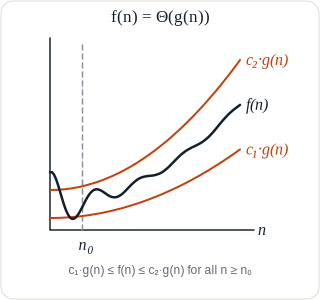
f ( n ) = Θ ( g ( n ) ) f(n) = \Theta(g(n)) f ( n ) = Θ ( g ( n )) f f f Big-Theta of g g g c 1 c_1 c 1 c 2 c_2 c 2 n 0 n_0 n 0 0 ≤ c 1 g ( n ) ≤ f ( n ) ≤ c 2 g ( n ) for all n ≥ n 0 . 0 \le c_1\, g(n) \le f(n) \le c_2\, g(n) \quad \text{for all } n \ge n_0 . 0 ≤ c 1 g ( n ) ≤ f ( n ) ≤ c 2 g ( n ) for all n ≥ n 0 .
Intuition
Θ \Theta Θ n n n f ( n ) f(n) f ( n ) g ( n ) g(n) g ( n ) f f f g g g
Notation Read as Inequality for n ≥ n 0 n \ge n_0 n ≥ n 0 Analogy with numbers f = O ( g ) f = O(g) f = O ( g ) at most f ( n ) ≤ c g ( n ) f(n) \le c\, g(n) f ( n ) ≤ c g ( n ) a ≤ b a \le b a ≤ b f = Ω ( g ) f = \Omega(g) f = Ω ( g ) at least f ( n ) ≥ c g ( n ) f(n) \ge c\, g(n) f ( n ) ≥ c g ( n ) a ≥ b a \ge b a ≥ b f = Θ ( g ) f = \Theta(g) f = Θ ( g ) exactly (up to constants) c 1 g ( n ) ≤ f ( n ) ≤ c 2 g ( n ) c_1 g(n) \le f(n) \le c_2 g(n) c 1 g ( n ) ≤ f ( n ) ≤ c 2 g ( n ) a = b a = b a = b
Theorem 2.23 · Θ is O and Ω together
For any functions f f f g g g f ( n ) = Θ ( g ( n ) ) f(n) = \Theta(g(n)) f ( n ) = Θ ( g ( n )) f ( n ) = O ( g ( n ) ) f(n) = O(g(n)) f ( n ) = O ( g ( n )) f ( n ) = Ω ( g ( n ) ) f(n) = \Omega(g(n)) f ( n ) = Ω ( g ( n ))
The study material states this without proof. The proof is short:
(⇒ \Rightarrow ⇒ c 1 g ≤ f ≤ c 2 g c_1 g \le f \le c_2 g c 1 g ≤ f ≤ c 2 g n ≥ n 0 n \ge n_0 n ≥ n 0 c = c 2 c = c_2 c = c 2 c = c 1 c = c_1 c = c 1
(⇐ \Leftarrow ⇐ f ≤ c 2 g f \le c_2 g f ≤ c 2 g n ≥ n 1 n \ge n_1 n ≥ n 1 f ≥ c 1 g f \ge c_1 g f ≥ c 1 g n ≥ n 2 n \ge n_2 n ≥ n 2 n ≥ n 0 = max ( n 1 , n 2 ) n \ge n_0 = \max(n_1, n_2) n ≥ n 0 = max ( n 1 , n 2 )
Check Your Progress 2: the Ω and Θ parts
Example 2.24 Prove 3n² + 7n − 5 = Θ(n²) (part c)
Goal. Find c 1 , c 2 > 0 c_1, c_2 > 0 c 1 , c 2 > 0 n 0 n_0 n 0 c 1 n 2 ≤ 3 n 2 + 7 n − 5 ≤ c 2 n 2 c_1 n^2 \le 3n^2 + 7n - 5 \le c_2 n^2 c 1 n 2 ≤ 3 n 2 + 7 n − 5 ≤ c 2 n 2 n ≥ n 0 n \ge n_0 n ≥ n 0 Lower bound. For n ≥ 1 n \ge 1 n ≥ 1 7 n − 5 ≥ 2 > 0 7n - 5 \ge 2 > 0 7 n − 5 ≥ 2 > 0 3 n 2 + 7 n − 5 ≥ 3 n 2 3n^2 + 7n - 5 \ge 3n^2 3 n 2 + 7 n − 5 ≥ 3 n 2 c 1 = 3 c_1 = 3 c 1 = 3 Upper bound. Drop − 5 -5 − 5 7 n 7n 7 n 3 n 2 + 7 n − 5 ≤ 3 n 2 + 7 n 2 = 10 n 2 3n^2 + 7n - 5 \le 3n^2 + 7n^2 = 10n^2 3 n 2 + 7 n − 5 ≤ 3 n 2 + 7 n 2 = 10 n 2 n ≥ 1 n \ge 1 n ≥ 1 c 2 = 10 c_2 = 10 c 2 = 10 Combine. Both hold for n ≥ 1 n \ge 1 n ≥ 1 Result. 3 n 2 ≤ 3 n 2 + 7 n − 5 ≤ 10 n 2 3n^2 \le 3n^2 + 7n - 5 \le 10n^2 3 n 2 ≤ 3 n 2 + 7 n − 5 ≤ 10 n 2 n ≥ 1 n \ge 1 n ≥ 1 3 n 2 + 7 n − 5 = Θ ( n 2 ) 3n^2 + 7n - 5 = \Theta(n^2) 3 n 2 + 7 n − 5 = Θ ( n 2 )
(g) max { f ( n ) , g ( n ) } = Θ ( f ( n ) + g ( n ) ) \max\{f(n), g(n)\} = \Theta(f(n) + g(n)) max { f ( n ) , g ( n )} = Θ ( f ( n ) + g ( n )) (for non-negative f , g f, g f , g 1 2 ( f ( n ) + g ( n ) ) ≤ max { f ( n ) , g ( n ) } ≤ f ( n ) + g ( n ) . \tfrac12\big(f(n) + g(n)\big) \le \max\{f(n), g(n)\} \le f(n) + g(n). 2 1 ( f ( n ) + g ( n ) ) ≤ max { f ( n ) , g ( n )} ≤ f ( n ) + g ( n ) . c 1 = 1 2 c_1 = \tfrac12 c 1 = 2 1 c 2 = 1 c_2 = 1 c 2 = 1 n 0 = 1 n_0 = 1 n 0 = 1 max { n , n 2 } = n 2 \max\{n, n^2\} = n^2 max { n , n 2 } = n 2 n + n 2 = Θ ( n 2 ) n + n^2 = \Theta(n^2) n + n 2 = Θ ( n 2 )
(i) f ( n ) + g ( n ) = Θ ( min { f ( n ) , g ( n ) } ) f(n) + g(n) = \Theta(\min\{f(n), g(n)\}) f ( n ) + g ( n ) = Θ ( min { f ( n ) , g ( n )}) Counterexample: f ( n ) = n f(n) = n f ( n ) = n g ( n ) = n 2 g(n) = n^2 g ( n ) = n 2 f + g = n + n 2 = Θ ( n 2 ) f + g = n + n^2 = \Theta(n^2) f + g = n + n 2 = Θ ( n 2 ) min { n , n 2 } = n \min\{n, n^2\} = n min { n , n 2 } = n n 2 ≠ O ( n ) n^2 \ne O(n) n 2 = O ( n )
(j) 33 n 3 + 4 n 2 = Ω ( n 2 ) 33n^3 + 4n^2 = \Omega(n^2) 33 n 3 + 4 n 2 = Ω ( n 2 ) For all n ≥ 1 n \ge 1 n ≥ 1 33 n 3 + 4 n 2 ≥ 4 n 2 ≥ n 2 33n^3 + 4n^2 \ge 4n^2 \ge n^2 33 n 3 + 4 n 2 ≥ 4 n 2 ≥ n 2 c = 1 c = 1 c = 1 n 0 = 1 n_0 = 1 n 0 = 1
Correction · Answer to Check Your Progress 2 (j)
Study material says: The answer in §2.9 says no constants satisfy the inequality and concludes that 33 n 3 + 4 n 2 33n^3 + 4n^2 33 n 3 + 4 n 2 Ω ( n 2 ) \Omega(n^2) Ω ( n 2 ) C ⋅ n C \cdot n C ⋅ n n 4 n^4 n 4 n 2 n^2 n 2
Correct version: The statement is true : 33 n 3 + 4 n 2 ≥ 1 ⋅ n 2 33n^3 + 4n^2 \ge 1 \cdot n^2 33 n 3 + 4 n 2 ≥ 1 ⋅ n 2 n ≥ 1 n \ge 1 n ≥ 1 33 n 3 + 4 n 2 = Ω ( n 2 ) 33n^3 + 4n^2 = \Omega(n^2) 33 n 3 + 4 n 2 = Ω ( n 2 ) c = 1 c = 1 c = 1 n 0 = 1 n_0 = 1 n 0 = 1
Why: Ω is a lower bound, and the definition is met directly: 33 n 3 ≥ 0 33n^3 \ge 0 33 n 3 ≥ 0 33 n 3 + 4 n 2 ≥ 4 n 2 ≥ n 2 33n^3 + 4n^2 \ge 4n^2 \ge n^2 33 n 3 + 4 n 2 ≥ 4 n 2 ≥ n 2 n ≥ 1 n \ge 1 n ≥ 1 n 3 n^3 n 3 n 2 n^2 n 2 n n n n n n n 4 n^4 n 4
Key idea
Ω \Omega Ω O O O Θ \Theta Θ f = Θ ( g ) f = \Theta(g) f = Θ ( g ) f = O ( g ) f = O(g) f = O ( g ) f = Ω ( g ) f = \Omega(g) f = Ω ( g )
Common mistake
Thinking that f = Ω ( g ) f = \Omega(g) f = Ω ( g ) f f f g g g n 3 = Ω ( n 2 ) n^3 = \Omega(n^2) n 3 = Ω ( n 2 ) Θ \Theta Θ
Common mistake
Using c = 0 c = 0 c = 0
Note
Two more notations, little-o and little-omega, express strict growth (f f f g g g
TEE Exam note
For a Θ proof, write the double inequality c 1 g ( n ) ≤ f ( n ) ≤ c 2 g ( n ) c_1 g(n) \le f(n) \le c_2 g(n) c 1 g ( n ) ≤ f ( n ) ≤ c 2 g ( n ) n 0 n_0 n 0
Key takeaways
f = Ω ( g ) f = \Omega(g) f = Ω ( g ) f ( n ) ≥ c g ( n ) f(n) \ge c\,g(n) f ( n ) ≥ c g ( n ) n ≥ n 0 n \ge n_0 n ≥ n 0 c > 0 c > 0 c > 0 f = Θ ( g ) f = \Theta(g) f = Θ ( g ) c 1 g ( n ) ≤ f ( n ) ≤ c 2 g ( n ) c_1 g(n) \le f(n) \le c_2 g(n) c 1 g ( n ) ≤ f ( n ) ≤ c 2 g ( n ) n ≥ n 0 n \ge n_0 n ≥ n 0 Θ = O + Ω \Theta = O + \Omega Θ = O + Ω n 0 n_0 n 0 max { f , g } = Θ ( f + g ) \max\{f, g\} = \Theta(f + g) max { f , g } = Θ ( f + g ) 33 n 3 + 4 n 2 = Ω ( n 2 ) 33n^3 + 4n^2 = \Omega(n^2) 33 n 3 + 4 n 2 = Ω ( n 2 )
Practice questions Answer on paper first, then check. The explanation matters more than the letter you chose.
Question 1 · multiple choice Check answer
Show answer Answer: B. n 3 = Ω ( n 2 ) n^3 = \Omega(n^2) n 3 = Ω ( n 2 )
n³ ≥ 1·n² for n ≥ 1. The others reverse the direction: n² does not grow at least as fast as n³.
Question 2 · multiple choice Which constants prove 3 n 2 + 7 n − 5 = Θ ( n 2 ) 3n^2 + 7n - 5 = \Theta(n^2) 3 n 2 + 7 n − 5 = Θ ( n 2 ) n ≥ 1 n \ge 1 n ≥ 1
Check answer
Show answer Answer: D. c 1 = 3 c_1 = 3 c 1 = 3 c 2 = 10 c_2 = 10 c 2 = 10
3n² ≤ 3n² + 7n − 5 ≤ 10n² for n ≥ 1. c₁ = 0 is not allowed, and with c₂ = 3 the upper bound fails because 7n − 5 > 0.
Question 3 · multiple choice If f ( n ) = O ( n 2 ) f(n) = O(n^2) f ( n ) = O ( n 2 ) f ( n ) = Ω ( n 2 ) f(n) = \Omega(n^2) f ( n ) = Ω ( n 2 )
Check answer
Show answer Answer: B. f ( n ) = Θ ( n 2 ) f(n) = \Theta(n^2) f ( n ) = Θ ( n 2 )
By the theorem, O and Ω together give Θ. It does not mean f equals n²; for example 5n² + 3 also satisfies both.
Question 4 · multiple choice max { n 2 , n 3 } \max\{n^2, n^3\} max { n 2 , n 3 }
Check answer
Show answer Answer: C. Θ ( n 2 + n 3 ) = Θ ( n 3 ) \Theta(n^2 + n^3) = \Theta(n^3) Θ ( n 2 + n 3 ) = Θ ( n 3 )
max{f, g} = Θ(f + g), and n² + n³ = Θ(n³). n⁵ would be the product, not the sum.
Question 5 · multiple choice Why must the constant c c c
Check answer
Show answer Answer: D. With c = 0 c = 0 c = 0 Ω \Omega Ω
f(n) ≥ 0·g(n) is always true for non-negative f, so the notation would say nothing.
Question 6 · short answer
Prove that 1 2 n 2 − 3 n = Θ ( n 2 ) \tfrac{1}{2}n^2 - 3n = \Theta(n^2) 2 1 n 2 − 3 n = Θ ( n 2 ) c 1 c_1 c 1 c 2 c_2 c 2 n 0 n_0 n 0
Show worked answer Upper bound: ½n² − 3n ≤ ½n² for all n ≥ 1, so c₂ = ½. Lower bound: we want ½n² − 3n ≥ c₁n². Dividing by n²: ½ − 3/n ≥ c₁. For n ≥ 12, 3/n ≤ ¼, so ½ − 3/n ≥ ¼; take c₁ = ¼. Hence ¼n² ≤ ½n² − 3n ≤ ½n² for all n ≥ 12, i.e. c₁ = ¼, c₂ = ½, n₀ = 12.