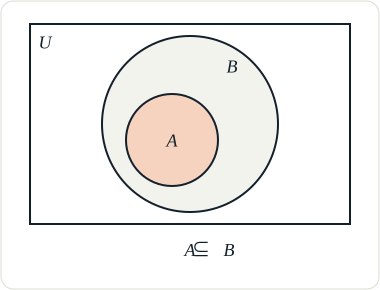
Sets are often contained in other sets: the set of MCA students is inside the set of IGNOU students. This section gives names to that relationship, counts all the subsets of a set, and introduces Venn diagrams, which let us “see” sets.
For example, {4,5,6}⊂{4,5,6,7,8}, while {3,4}⊆{4,5,6,7,8} because 3 is missing. Two facts are useful: ∅⊆A and A⊆A for every set A; and if A⊆B and B⊆C, then A⊆C.
The power set
P({1,2})={∅,{1},{2},{1,2}}. Always ∅∈P(A) and A∈P(A).
Proof by induction on n. Basis n=0: A=∅ has exactly one subset, ∅, and 20=1. Step: assume every set with k elements has 2k subsets. Let A={x1,…,xk,xk+1} and B={x1,…,xk}. Each subset of A either does not contain xk+1 (then it is one of the 2k subsets of B) or contains it (then it is a subset of B with xk+1 added — again 2k choices). So ∣P(A)∣=2k+2k=2k+1. ■
Universal set and Venn diagrams
The universal set U is a set that contains every set under discussion; we choose it at the start of a problem and keep it fixed. In a Venn diagram (introduced by John Venn, 1834–1923) U is drawn as a rectangle and its subsets as circles or other closed shapes inside it.
Key takeaways
A⊆B: every element of A is in B; A=B iff A⊆B and B⊆A.
∅⊆A and A⊆A for every set A.
∣P(A)∣=2∣A∣, proved by induction or by “take it or leave it” counting.
The universal set is fixed for a problem; Venn diagrams draw it as a rectangle.
Practice questions
Answer on paper first, then check. The explanation matters more than the letter you chose.
Question 6 · short answer
List all subsets of {x,y,z} that contain x, and explain why there are exactly 22 of them.
Show worked answer
{x}, {x,y}, {x,z}, {x,y,z}. Each such subset must contain x, and for the remaining elements y and z we choose independently “take” or “leave” — 2×2=4=22 choices. (Together with the 4 subsets without x this gives all 23=8 subsets.)
MCA Online notes are made for reading on screen. Open https://mcastudy.online/mcs-212/sets-relations-and-functions/subsets-power-sets-and-venn-diagrams/ to read this page.